Showing posts with label by Todd Marsh. Show all posts

Saturday, 13 July 2013

Digital Canvas Special - Rocketbot.com


In this very special edition of Digital Canvas, I’ll be interviewing my own dear sister to learn more about Rocketbot.com, a site that she’s involved with and thinks that us comic-reading chaps would find interesting!

Todd Marsh: Please give us a brief description of the Rocketbot website for people who haven’t heard of it:

Becky Marsh: Rocketbot is a community site for comic creators/lovers of all ages and skill levels. It’s a place for creators to practise, grow and develop, gaining valuable feedback, hints and tips on making the best of your comic. It’s also a place to share ideas, find like-minded people and collaborate to bring new comics to life.

TM: How is it different from other art-sharing/showcase websites like Deviantart etc?

BM: Where other artistic communities welcome all kinds of art, Rocketbot is just focused on creating comics first and foremost, and all that goes into making comics. It’s difficult on sites like Deviantart to find like-minded people that can help you in a specific area. Rocketbot is all about comics and that’s rather refreshing.

Plus the creators of the site; Gene and Mary, are always on hand to talk to you directly, taking the time to reply with measured suggestions or criticism.


TM: How did you get involved with Rocketbot?

BM: I was lucky enough to already know the co-creator and head cheerleader Gene Kelly through a different site and when he announced his big new website project, I was happy to come along and sign up once Rocketbot had gone live. I am very pleased I did!

TM: Is it an easy site to join?

BM: Perfectly! Anyone can join and what’s more it’s completely free! You can still enjoy the website as a non-member, but membership is needed to upload comics.

TM: And for people who just like to browse, are there any comics or artists you’d particularly recommend?

BM: I’d certainly recommend the top man Gene Kelly himself! An all-rounder with a great sense of humour. His comics (including sibling superheroes Rocket and Bounce) are always impressively done, full of detail, and can always inspire me.

Matt Seniour is another guy who never ceases to amaze me (or make me laugh). His comic Battlecakes is one of my favourites on Rocketbot. Simple, colourful, a great twist on the norm. Trust me you will love this delicious comic!

Or for something a little more serious and mysterious you can’t go wrong with Seyrah’s “The Many Quantum Adventures of Alexandra Byers.” The perspectives, layouts and details in her comics are always pleasing, but what I enjoy most is her amazing storytelling.

TM: The site collectively brought out a graphic novel recently, could you tell us about that? (And where you can get hold of a copy?)

BM: The 1st Rocketbot Anthology was a great way to show off the site’s diversity of comic creators. This anthology was created by the Rocketbot community to highlight the amazing talent and creativity that can be found there. I myself managed to take part, collaborating with Gene to produce “The Explorer”, a short tale about an adventurous girl, her talking monkey and a magic map. It is such an amazing feeling to have your own work out there in print and was such a boost to me when the finished book came through the post. It was also the first time I had worked from someone else’s script. A fantastic learning curve and something I’m looking forward to doing again!

The anthology is available from Amazon: https://www.createspace.com/4107646

TM: Thank you dear sister.

Todd Marsh is paying off Tom Nook one bell at a time.

Saturday, 8 June 2013

Funny Pages - Adventure Time

Now consider the armadillo. In the great metaphorical zoo of entertainment, there’s room for a wide variety of animals. For those people who enjoy their comedy to be on the black side or at least more “adult”, look no further than the bat enclosure or the anteater pen (check out that proboscis!). And of course if you’ve brought the kids along, they’ll want to make a beeline to the petting zoo of comedy, or more appropriately for this extended metaphor, they should visit the tortoises (fairly amiable with a tough shell made of innocence and censors).


But for this article, we’ll be focusing on the middle ground, the armadillos of entertainment. Armadillos still have the safety shell, the layer of innocence, but there are chinks in the armour that give us a peek of something deeper. It’s certainly not easy, being an armadillo. They walk a thin tightrope, constantly in danger of teetering towards either immaturity or adulthood. A successful example would be the output of the Pixar studio, films with a strong-enough story to hook adults and children alike, with laughs catering to both camps.

 Let me just say right now, the Adventure Time show and now the tie-in comics are utterly glorious armadillos. Adventure Time follows the 13 year-old hero Finn, his best friend Jake the magical dog, and their many exciting, zany adventures in the fantastical Land Of Ooo. Rescuing princesses, fighting evil monsters, exploring daunting mazes and forgotten caverns, on the surface it appears to be a fun, simple concept, ideal for rowdy youngsters. But look closer, watch with adult eyes, and it becomes clear that there’s a lot of hidden depth, especially emotional depth in the character interactions.

In the comic, writer Ryan North has taken all the very best ideas from the show, mixed them with his own, managed to keep the voices of the familiar characters intact, and continually churns out page after page of pure joy. What I love about North’s writing is that it’s inherently obvious that he is having the time of his life creating these comics, with this creative team. And when he’s having fun, we the readers have fun! Not only that, North uses the comic pages, the medium itself, to its fullest potential. Little jokes and commentary in the margins, playful “extra panel” asides at the bottom of certain pages, the glorious “choose your own adventure” standalone issue and it’s playful experimentation with the fourth wall… put simply, Ryan North’s armadillo does wonderful tricks!


But we mustn’t give Mr North all the glory! The regular artists Shelli Paroline and Braden Lamb consistently make every page shine, successfully inhabiting the whimsical yet deceptively detailed design of the Adventure Time world. I love their artistic versatility; able to pull off a subtle style change to reference the much-simpler animated pilot episode during a bout of time travel shenanigans, and the pixel art of a recent video-game-centric issue was a joy to behold. The eye popping colour and silly facial expressions may not be what many “serious” comic readers are used to, but to me it’s like a great big chocolate pudding of fun and I’m one of too few people with a spoon.

Generously, the shorter back-up stories in each comic are often on par with or even surpass the main story, and are provided by a host of diverse creative types who want to get in on a good thing when they see it. Comic book pros such as Paul Pope, Shannon Wheeler, and Chris Houghton have all answered the call, as have the wide network of Ryan North’s webcomic buddies (who all seem to be friends with each other) like Anthony “Nedroid” Clark, Zack “Magical Game Time” Gorman, and Becky “Tiny Kitten Teeth” Dreistadt. The results are breathtakingly different in both art and story, but they all manage to stay true to the ethos of “fun” that this comic emanates like a wonderful odour.

Let me just wrap up by advising you all to pick up this comic. It’s like a tightrope-walking circus-trick-performing armadillo that tastes of chocolate pudding and smells gorgeous. But better.

Todd Marsh has doubts about his own sanity after writing this article.

Saturday, 11 May 2013

Funny Pages - Chew

I’m a fan of fun.

Unashamedly, unreservedly. I don’t shy away from humorous books or comics and dismiss it as “kid’s stuff”, I seek out a good chuckle-maker as a rare prize. Sure, darker comics often lead me joyously astray (to the streets of Gotham more often than not), but I always return to fun with a warm handshake and a novelty hand buzzer. After all, it’s relatively easy to play on the fears and personal dramas of a world full of such things (according to the press anyway), but it’s a much harder, more worthy job to seek out the good in life - the things that make you smile or laugh - and try to replicate and supplement them.

In this vein, I find myself starting a new series of articles to celebrate those happy few comics that truly are “comic”. I’ve chosen a short-list of only the best: comic books that have made me personally laugh, out loud, with my actual mouth. It’s a very exclusive club, as anyone who has typed “LOL” whilst wearing a stoic expression would attest. And to allay fears that “funny” doesn’t have to mean “kiddy”, let’s start with the Image Comics series Chew.


Written by John Layman with art by Rob Guillory, Chew appeals directly to the weirder side of my sense of humour. It’s certainly one of the most unique stories I’ve ever come across! Chew deals with a world where a mysterious plague befell the USA only a handful of years before the present day, which the American government blamed on Bird Flu and promptly banned all chickens from the country. So with that fairly believable set-up, you’re already reading a comic book filled with chicken dinner speakeasies, gangsters smuggling poultry, and big businesses experimenting on frogs to get them to taste like chicken! But then it gets weird. The main protagonist, Tony Chu, is a cop who has a very specific superpower: whatever he eats, he gets a psychic impression of the history of that piece of food. He sees the cow being slaughtered for the burger. He watches the apple being sprayed with pesticide. So when the Food and Drug Administration (the most powerful Feds in the country due to the chicken situation) get wind of his powers, he has to start chowing down on dead bodies (and worse!) to solve cases.

It turns out that several characters throughout the story have food-based powers, and it’s delightful how creative these are. John Layman has done the seemingly impossible and thinks up brand new superpowers in a comic book industry awash with superheroes. He continually impresses with the sheer scale of weirdness he lays onto his fast-paced plot, never once allowing it to collapse under the weight of absurdity. Cyborgs, alien plant life, conspiracies, terrorists who look like mime artists, it all just blends together effortlessly to yank up the corners of your mouth and not let go.


Complementing this nicely is Rob Guillory’s gritty, detailed art, which works as the perfect accompaniment to Layman’s narrative. Guillory presents the world of Chew as a grimy, dirty cesspit full of disorder and food crumbs, lifted only by the wonderfully witty sight gags and Easter Eggs that litter each page. Mirroring the story nicely, the art reminds us that this is a grim world that’s stained around the edges, but it helps to laugh at it. A bit of advice though; don’t read these comics whilst eating, or you may lose your appetite. No punches are pulled, no meal left unsavoured! Not to go into too much detail, but a stand out moment for me is when Tony falls in love, and the scene manages to be emotionally touching, hilarious, and truly disgusting at the same time.

Laugh Out Loud Moment: When Tony’s hateful boss dreams of murdering Tony or allowing him to die, then reluctantly remembers how much paperwork that would cause. A close second (not counting the aforementioned love-at-first-sight scene) would be the introduction of Poyo, the uber-deadly, constantly angry, cock fighting Mexican rooster that impressively stacks up his body count whenever the story catches up with him. The famously murderous chickens from the Zelda videogames have nothing on the force of nature that is Poyo. It's little wonder that he once got his own solo one-shot issue!

Todd Marsh is hoping to continue his Digital Canvas articles as soon as the muse allows it.

Tuesday, 7 May 2013

Free Comic Book Day 2013 - many thanks!

Thank you to everyone who helped to make Free Comic Book Day 2013 at Proud Lion such a roaring success! 

We exceeded last year's phenomenal event in every way. More comics, a larger selection, a bigger turn out... AND we ran out of comics quicker than last year too!


The photo below shows just how huge the spread on offer was before we opened the doors. Apologies to anyone who missed out, we had loads and it still wasn't enough! 

The right side features all the kids comics we also had on offer at the start of the day. Thanks to every grown up who respected our request to limit their selections from from this section to two, so that more children could get chance to get free comics! We still ran out by midday! 


We had some fantastic cosplayers on the day and it was a genuine pleasure to give out free Iron Man 3 HeroClix to those in costume. There were Watchmen, Sith, Ewoks, Batman, Iron Man and an awesome female Han Solo! Congratulations to everyone, you looked wonderful! (Thanks to Todd Marsh for the photos.)


Many thanks to everyone who persevered through the busiest part of the day, when we had to limit the people upstairs to one out, one in. And my eternal gratitude to everyone who helped out, which includes anyone who made a purchase or gave a generous donation to charity.


We had cookies and cakes on offer on the day! In the end, our bakers helped us raise £40 for Winston's Wish!

Roll on next year. Saturday 3rd May - save the date!

Ben Fardon is loving the beautiful weather.

Saturday, 16 February 2013

Digital Canvas - an interview with Ryan North

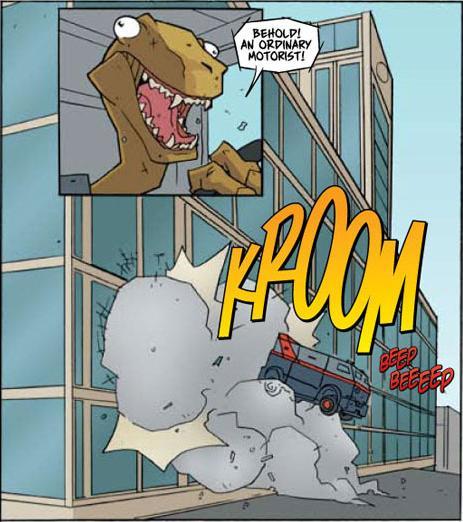
In my continuing efforts to interview creators with the unique perspective of working both in print and web comics, I’ve managed to steal a bit of precious time away from Ryan Q. North, the legend behind the ever popular qwantz.com and the rather superb Adventure Time print comic!


Todd Marsh: So for people who don't know, how did you first get into webcomics?

Ryan North: I started in 2003, when we had a class assignment to "do something interesting with a website". My group didn't really do much so I said "WELL I WANT TO MAKE A COMIC" and put up the first comic over the weekend and that was it!

TM: And how did that lead to writing print-comics? Was one a stepping stone to the other?

RN: Yep! Almost literally. The editor for Adventure Time liked Dinosaur Comics and thought it'd be a good fit. Web comics are great because they're so accessible: people who wouldn't otherwise see your comic can see it. Plus it shows that you can meet a deadline and tell a joke, which I guess are useful skills that editors of comedy comics will look for?

TM: Do you find the different mediums affect how you write? For example with readers seeing one page of webcomic at a time rather than a whole issue of print-comic?

RN: Well yeah, for sure. The medium affects what's being told in lots of ways. The nice thing about Adventure Time (which kills me in ordinary superhero books) is that there's no ads interrupting the story. That's super critical, because that lets you as a writer know what page you're working on AND where it's situated physically on the page. I love to know if the next page is already visible or if the reader has to turn the page to see what happens next. It's a small thing, but it lets you structure the story so a mini cliffhanger can last longer and be a surprise! It's less of a surprise if they can glance over and see how it's resolved.

Of course if you're doing a stand-alone webcomic that's less of an issue, but there's still ways you can control it. Visit qwantz.com in a browser and you'll see the whole comic, but visit on a mobile phone and you'll see one panel at a time. That was for space restrictions but I've gotten emails from people saying they prefer it that way, because then they can't spoil the punchline for themselves!

TM: Is one medium easier to write for than the other?

RN: They've both different.  I'm not sure if one's easier: it's like skateboarding vs riding a bike.  Both are fun and will get you where you're going, but you're exercising different muscles.

TM: Is it OK to talk money? Is it easier to make money from print comics?

RN: Sure! But "easier to make money" is super wide open. Lots of people make money without going online, and lots only work online and don't do stuff in print. It depends on your model, right? Like, most webcomics are put online for free and you WANT them to be shared, because that might lead people to become fans and then they might buy a shirt or a book collection. So you turn the fact that computers are really good copying machines into something that works. But if you're trying to sell JUST a print book then you're terrified if it shows up online, because that's your content and you've lost control of it and why would anyone buy the book now?

Anyway my Dinosaur Comics books are all collections of stuff available online and people still buy them, which is awesome!  Maybe it's because you can give a book as a present and it's a nice gift, but you can't yet write down "check out qwantz.com" on a piece of paper, wrap that up, and have it be just as nice.


TM: Do you agree with the perception that webcomic creators are closer to their fanbases due to things like page comments and social media? And is this a good thing?

RN: We're certainly very accessible. And I think that's a good thing! Honestly the people who read my comic tend to have my sense of humour, so when we're all hanging out on Twitter it's really fun. I tell a joke, people riff on it, we retweet the best of them and it's all really fun and easy. Someone with a business hat on would say that this is "organic engagement with pageview creators" or something but it's really just hanging out and having fun with pals. Who is not in favour of pals?

TM: Should regular comics and webcomics be competing or sharing the marketplace?
Do they even have the same "customers"?

RN: Haha, "regular comics". WHAT A LOADED WORD YOU HAVE CHOSEN THERE, MY FRIEND.

I don't think they're competing. People who like comics will probably like webcomics too, but there's a difference between reading one comic a day on my site and buying a trade paperback of print comics from someone else.  It's not the same thing, right? And there are people who read webcomics who'll say "I don't like comics" because they see them as different things (unfortunately) and there's people who read only print stuff.  I don't think there's a great conflict between the web and print worlds.

TM: What do you think of digital copies of regular comics, are they the future of the industry?

RN: Was radio the future of plays? Was television the future of radio? They're different beasts, I think. Both can coexist easily, but it may take some marketplace adjustment.


TM: What with various TV and film, print comics are very much in the popular mindset at the moment. Will webcomics ever get that recognition?

RN: Sure! Why not? But I'm not sure what that recognition is worth. When Twitter accounts can become TV shows, the idea of being "tapped" by some god on high to enter The Mainstream kinda loses its appeal, a little? And then you see it as just "oh a company wanted to make money off of this synergistic cross-platform media francise, I get it now" instead of "wow TV, how does that even happen??".

TM: Think about your favourite print comics and webcomics. Would they still work if they were in the opposite medium? Would you like to see a webcomic companion series or spinoff to a print-comic for example?

RN: Sure! I mean they're obviously different things, but I don't see any tension between the media. You call them "opposite mediums" but I think the opposite of a print comic is like - an audio recording of an opera? Maybe? Print and web are siblings, to me, not opposites. And there have been print comics hat have web comics as tastes or teasers for the book - Faith Erin Hick's Friends With Boys for example  - and web comics can move to print easily too.

TM: Finally, please use this space to plug anything you want to plug.

RN: Um, I'm working on a choose-your-own-path version of Hamlet that just became Kickstarter's most-funded publishing project ever! But this is a bad plug because the Kickstarter is over and you'll just have to wait till the book comes out for real now. But it's gonna be great, honest!

TM: Thanks again!

Todd Marsh would like to thank Ryan North for humouring my stupid questions with wise words.

Saturday, 2 February 2013

Digital Canvas - Two To Review: Cucumber Quest VS Ava’s Demon

In this week’s reviews, the golden thread binding our two webcomics together is art, specifically beautiful cel shading art. This may or may not be the correct term for this style, the term is more prevalent in videogame circles, but both featured webcomics are made up of borderless blocks of colour, sumptuous lighting and shade, and subsequently both were featured in my previous article regarding visually pleasing webcomics as a result.

Cucumber Quest is an ongoing story-driven comic split into chapters, and is created by the delightfully named Gigi D.G. The story takes place in a land of cute bunny people split into several kingdoms (each one intentionally based on typical videogame theme-level clichƩs), and follows very reluctant hero Cucumber, his much more adventurous sister Almond, and their quest to stop the evil Nightmare Knight.


What I love about Cucumber Quest is that it manages to both honour and mess with all the old “adventure quest” clichĆ©s we’re all familiar with. Cucumber is the most reluctant hero ever, he’d rather be in school, and he even sees clichĆ©s and plot holes rearing up in front of him. But he never manages to avoid this “destiny”, because life keeps forcing him down the path of a legendary hero. Similarly, his sister Almond is constantly fighting against the assumption that she is “just a girl” and ergo can’t be a legendary hero. She even takes steps (which I won’t mention here due to spoilers) to ensure the day isn’t saved too quickly and that the adventure goes ahead! And it certainly doesn’t hurt that the comic is laugh-out-loud funny throughout!

Of course, this webcomic isn’t to everybody’s tastes. Anyone who dislikes overly cute things will take one look at all the bunny people and (excuse the pun) turn tail without giving it a chance. Equally, anyone hoping for a serious adventure or gritty drama should look elsewhere. The Nightmare Knight is a suitably foreboding villain with great presence, but his underlings appear to struggle with actually posing any real threat to the heroes as of yet. You get the sense that everything will probably work out fine without much fuss.

Ava’s Demon is a long-form webcomic split into chapters, created by Michelle Czajkowski. The story follows Ava, a seemingly ordinary girl in a futuristic world of spacecraft, aliens, and mega-corporations, Ava has a more medieval problem; there’s a demon in her head that only she can see. What this demon actually turns out to be is the crux of the story.


The feature that Ava’s Demon most excels at is atmosphere. Ambience leaks from the borders of each page in bucket-loads, and the fascinating story hooked me with ease and the juicy bait of believable characterisation. The artwork is simply beautiful, and whilst it does share a few elements and techniques with the previous webcomic, I would describe Czajkowski’s art as what Cucumber Quest hopes to be when it grows up. The strip is funny in places, but isn’t afraid to be hard-hitting when needed, and in a certain light it could be seen as a commentary on mental health issues (although I’m probably just reading into things that aren’t there).


The main problem I see with this strip is the design choice of having one panel of story per page. Stylistically, I see why Czajkowski chooses to do this; the reader is encouraged to examine each panel longer and therefore proceed through the story at a steady tempo, and of course the art benefits from the extra focus. But reading through the archives in one sitting as I did for this review, I found myself getting impatient with the pace. Maybe I’m just spoilt by other multi-panelled webcomics. I also find myself inexplicably uncomfortable with the lack of sound effects (visually I mean, like a well-placed CLONK or SPLORT in the panel) leading to an odd feeling of silence pervading the strip. I really am digging to find constructive faults here, which just shows how great I think this webcomic is.

OK, time for the verdicts. Cucumber Quest is a wonderful tale spun by a gifted storyteller, and full of guaranteed laughs (and for that reason alone has found its way onto my Favourites bar), but in comparison to Ava’s Demon it comes off too slight. Ava and her cohorts have well and truly sunk their collective claws into me, and are the deserved winners of this little face-off.

Todd Marsh still uses overly fanciful words to try and convey pure emotions.

Saturday, 1 December 2012

Digital Canvas - an interview with Brian Clevinger

In what I hope becomes a regular feature, I had good fortune to interview a comic book writer with experience in both print and web comics, hoping to gain their unique insight into both mediums.

This week I’ve been corresponding with Brian Clevinger – the creator of the now finished webcomic 8-bit Theater, and the writer of superb adventure comic Atomic Robo.

Todd Marsh: For those who don't know, how did your webcomic work begin?

Brian Clevinger: 8-bit Theater began completely by accident. I had just finished writing my first novel so it was time to find something else to waste all my time. I’d just signed up for an Independent Study course focusing on comics at the University of Florida. So, hey, I’d make my own comic from scratch and talk about the intersection between practical and theoretical concerns.

I used old video game images because I cannot draw. At all. Any gorilla could out-draw me, no contest. I made the comics funny just to keep myself interested enough to not fail the course. I put the pages online because my professor was terrible at keeping track of emails.

About nine months later I dropped out of college to work in comics full time.

TM: And how did that lead to print comic work? Would you say that one was a stepping stone to the other?

BC: Well, our publisher contacted us because of some concept art I posted on my webcomic site. So, yeah, having a catalog of online work certainly didn’t hurt.

TM: Do you find that the different mediums affect your writing style? For example, the audience reading one webcomic page at a time versus reading one whole issue of print comic at a time?

BC: Sure, in print, you can generally see the next page, but it’s in the periphery. So, I’d argue that you’re always reading one page at a time. It’s just that there’s a much larger pause between the current page and the next one when you’re keeping up with a webcomic as it’s being produced.

You should seek to make each page worth reading individually whether you’re in print, online, doing a linear narrative, or just random gags. I took that thinking from the internet to print. You’ll notice in Atomic Robo we don’t really transition from one page to the next. A scene may happen on multiple pages, but each page is its own object.

There’s something meaningful or interesting on every page.

But really the main change for me was the introduction of structure. Glorious, beautiful structure. 8-bit Theater is over 1,200 pages because I had no structure. Every page was just whatever I thought would be funny or interesting that day.

With print comics, you’ve got 20/22 pages to an issue and that’s all the space you’ve got to tell your story or your chapter. So, it’s like the “every page is meaningful or interesting” but blown up in scale.

When your story is constrained by outside forces, that’s when you get clever about how to tell it.

TM: Do you find one medium easier to write for than the other?

BC: They’re pretty same-y, really. You can get super experimental with online and digital content in a way that print can’t replicate, and I’m glad we have people out there tackling that material, but it’s not the stuff I’m interested in creating. I’m boring and old and just want to make comics that are fun and accessible to anyone.


TM: The perception is that webcomic fanbases are more connected to the writers due to things like page comments and social media, would you say that's true?

BC: It’s certainly the perception, because all the tools for getting a webcomic onto screens are the same tools that get our personalities onto them too. But ultimately it comes down to how much effort the author makes to connect or to not. You can be the most directly accessible print guy or the most hermit-ed webcomic guy.

TM: Can we talk money? Is it easier to make money from print comics?

BC: It’s easier to get money out of print comics, because there’s so much momentum in the industry and its patrons that things cost money. Publishers, contracts, retailers, page rates, advances, royalties, and customers who expect to pay for the things they love are already baked in to print.

That said, the potential pay day in webcomics is much higher because you cut out the middlemen. It’s just you, the customer, and the cost of production. But it’s a much riskier game to play.

TM: Should print comics and webcomics be competing or sharing the marketplace? Do they even have the same "customers"?

BC: There is no real competition and the idea that one of these takes dollars from the other shows a terrible ignorance of the marketplace.

People want comics. This is a fact. Because of webcomics, more people habitually read comics today than at any time in our lives. The vast majority of these people didn’t come into comics reading through the print industry. The inane ins and outs of publication and retailers and Diamond Distribution are not a part of their world, and more importantly, would not be tolerated by them.

But they want comics. And, to them, reading comics on a screen is perfectly natural. Even preferred. In what way is this customer served by physical copies?

Conversely, if I want a trade paperback because I enjoy the act of owning a material copy and the physical experience of the object itself, then the digital material isn't of interest to me.

It would be idiotic to ignore either customer in a world where each can be easily catered to.

TM: What are your views on the relatively recent surge of digital copies of print comics? Would you say that digital copies are the future of the industry?

BC: Comics are pulp. They’re disposable entertainment. But there is nothing disposable about printing them on high quality glossy paper and selling them for $4.00. Digital storage and bandwidth are much, much cheaper. And getting cheaper. That’s pulp. That’s disposable.

Digital distribution is the future. That’s math talking. That doesn’t mean the death of print, and that doesn’t mean that publishers can’t thrive. It just means they have to adjust their services to match the evolving marketplace.

Oh, and they need to stop charging print prices for digital material. It’s absurd.


TM: Of course, print comics are very much in the general public's mindset what with all the films and TV shows around at the moment. Do you think we'll ever see anything similar with webcomics? Will [popular webcomic character] ever become a household name?

BC: Absolutely. Hollywood doesn’t care where ideas come from if there’s a dollar to be made.

There’s this great bit in Wodehouse where a producer, in this case of plays, decides whether or not to back plays based on what his eight year old thinks of them because your average audience is about as smart a small child.

So, if you thought Reality TV was intensely cynical, look out for the next Big Idea: whimsical and magical stories written by any 5 year old. Honey Boo Boo is the bridge.

TM: Finally, feel free to use this space to plug anything you need to plug.

Here’s all the Atomic Robo news that’s fit to print. http://www.atomic-robo.com/
Here’s where I write free fiction and blogs about writing. http://www.superexplosive.com/

Todd Marsh would like to thank Brian Clevinger for taking the time to provide us with his insights.

Saturday, 17 November 2012

Digital Canvas - Truth Is Beauty

Some time ago now, I wrote an article detailing why I thought that the art of a webcomic isn't the be-all and end-all, and that good writing should always come first. With that in mind, lets celebrate webcomics with the most beautiful artwork! I don't pretend to be an art critic by any means, so in this article I'll be letting the pictures do most of the talking. I apologise in advance, this may be a looong stretch of an article!

I've often mentioned Gunnerkrigg Court in my articles, but I feel that I can bear to repeat myself once more by saying what a glorious webcomic it is, especially in relation to the artwork. The muted palette does a lot to establish a wonderful atmosphere throughout, and the Court is a beautifully realised setting that our protagonists have bearly even scratched the surface of, if the following page is anything to go by:


Gunnerkrigg also benefits from healthy doses of surreality and symbolism, especially when dealing with the delightful trickster god Coyote or the troubled reality-altering girl Zimmy:


As you can tell, the creator Tom Siddell has improved immensly since those first few pages, especially since he quit his normal job to focus on the webcomic. Buy some of his stuff guys, and long may his webcomic flourish.

The Abominable Charles Christopher is a webcomic that is both beautiful and moving, with pages ranging from humour to melancholy. The story follows a silent sasquach who acts like a child, slowly gaining perspective on the world in a forest full of funny talking animals that is slowly being encroached upon by the influence of Man. The art is made up of blacks and light greys, and the artist Karl Kersch is particularly gifted in displaying fluid movement:


Throughout the strip, a deeper story involving animal deities is often hinted at, and when one of these enigmatic characters show up it's always a visual treat:

I wasn't surprised to later learn that Kersch has done various work for Marvel and DC, his talent truly shines through here.

The next webcomic I want to showcase, Cucumber Quest by Gigi D.G., is a twist on various boy-goes-on-adventure-to-save-the-kingdom stories and constantly plays/messes with the familiar themes of these age old tales. Also everyone is a rabbit-person! It has a gorgeous soft and flowing style in various pastel colours that gives the strip bags of atmosphere:


The use of light and shade is wonderful throughout, and the settings are beautifully imaginative:


Plus as an added bonus, the strip is truly hilarious throughout! Well worth a look!

And when I'm taking about beautiful webcomics, how can I fail to mention Evan Dahm's truly epic Rice Boy. Rice Boy starts off small and sneakily grows before your eyes to become a huge sprawling tale equal to any Lord Of The Rings or Iliad you'd care to mention, filled with themes of lost innocence and destiny versus choice, but coupled with a distinct storybook asthetic that fits the tone so well.


At times the art is naively simple, but when it calls for it the level of detail can be breathtaking:

Sadly, there are far more beautiful webcomics in the world than words I can use to write about them, so I'll wrap this up with a few special mentions of strips suggested to me specifically for this article by my good chums at the MSPA forums (shout out to the webcomics board!):

Lackadaisy by Tracy Butler, with its wonderfully fluid anatomy and use of greyscale:


Ava’s Demon by Michelle Czajkowski, with its breathtaking use of colour and dramatic lighting:


And finally Unsounded by Ashley Cope, which I can only describe as simply visually stunning:


I’d just like to reiterate that art shouldn’t be the be-all and end-all of choosing a webcomic to read, that should be reserved for the quality of writing, whether that be for punch lines or story lines. But often I find that good art goes hand in hand with good writing!

Todd Marsh just voted for Proud Lion in the Gloucestershire Echo Love To Shop Awards

Saturday, 29 September 2012

Digital Canvas - Two To Review: Paranatural vs. Vibe

This week’s Two To Review features webcomics that both follow a young teenage boy learning to use superpowers against spirit monsters, but more importantly, both of these webcomics were recommended to me specifically to review! Thanks MSPA forumite Pixel20!

Paranatural is a long-form webcomic split into chapters, created by Zach Morrison. The story follows a snarky sarcastic boy named Max who moves to a new town with his family, and not long afterwards gains the ability to see ghosts and spirits. So not only does he have the headache of trying to fit in to a new school and make new friends, he has the additional migraine of investigating and battling spectral weirdness with the help of the school’s “Activity Club” - a front for a group of supernaturally-inclined students led by the mysterious teacher Mr Spender.


The first thing you need to know about Paranatural is that it is seriously funny. Humour is the primary concern here, and in my opinion this comic ticks that box with gusto! Another big plus point is the art; after Max learns of the existence of ghosts, each painstakingly-drawn panel literally becomes a spot-the-spirit puzzle. Weird-shaped creatures fill every nook during indoor scenes, and the larger beasts lolloping on rooftops and swimming in the lake add to the beauty of every outdoor panel. An additional highlight is the energetic tone of the story. It may have been the speed in which I read through the archive, but to me the overall feel is that of a non-stop freight train, quickly passing through junctions of action and humour in quick succession, only briefly pulling in at stops for a quick hit of unexpected emotion or a silent scenery page.

Of course, the downside to a formula like this is that sometimes the train passes things by all too quickly. For example, Max briefly touches on the subject of his dead mother in a bonding conversation with a new ghost friend, but this quickly gets interrupted by the introduction of the next big spirit antagonist to fight. And it’s clear that the fantastical elements of the setting runs on fixed rules, but it appears that for the most part these rules don’t even matter that much to the author, merely acting as stop-gap explanations of why this thing is trying to kill you now. Another drawback to this comic is the bewilderingly large cast of characters - when Max starts his new school the audience is just as in-at-the-deep-end as him, meeting potential new friends and enemies as well as the array of goofy teachers to contend with.


Vibe is a long-form webcomic split into chapters, created by Dan Ciurczak. Vibe revolves around the character Baron, a teenage boy learning the ropes of being a Witch Doctor, which entails him seeking out people with bad emotional problems and physically manifesting these bad “vibes” as huge monsters he then battles and defeats. While he does this, the long-term story arc concerns Baron’s quest to find his missing sister, who is hinted to have gone to the bad side of voodoo.


Vibe takes itself a lot more seriously than Paranatural, with humour used sparingly via banter between Baron and his pocket-sized Loa (voodoo spirit) companions, whose powers he borrows to fight the bad vibes. Of the two webcomics, Vibe is the place to be if you want a deeper, more involved story. The artwork is utterly gorgeous, and would not look out of place alongside the best examples of Marvel or DC art. I especially like the use of vibrant colour and lighting against the backdrop of the dark city at night, when much of the action takes place.

There are elements of the comic that I personally don't like though, including the heavy use of graffiti-inspired special effects and the writing used to capture the accent of the antagonist character Furio. I totally understand that the story has strong links with specific cultures but I’d just like to understand what he’s saying without carefully re-reading every word bubble.

Compared side by side, it appears that these webcomics share a great deal of similarities. But to me there is a very clear winner that has earned its place on my favourites bar, and that would be the hilarious Paranatural.

Todd Marsh learned everything he needed to know about ghosts from the Ghostbusters films.

EDITOR'S NOTE: this article was edited on Monday 1st October, following a retraction. We apologise for any offence the original article may have caused.

Saturday, 1 September 2012

Digital Canvas - Moving Pictures

In previous articles I have talked about how some webcomics utilise the opportunities of their chosen media by including various Flash or GIF animations to create a mixture of moving and stationary art. But what of those creators who decide to go all the way, creating a series of animations to rival their favourite Saturday-morning cartoons via the advent of the internet? This article is for those brave few.

If you’re wanting to discover a great animated web-series, a good place to start is a video/animation-sharing community site such as YouTube or Newgrounds, where creative types can easily upload their works and receive almost instant kudos or much-needed criticism.

A good example on the Newgrounds site is a Korean series called “There She Is!!”, made by a small independent animation studio called SamBakZa. The series of short cartoons (mostly set to music and without dialogue so as to cater to an international audience) follows a rabbit girl falling in love with a cat boy, in a world where inter-species romance is seen as taboo. The first few episodes are light-hearted and filled with humour, but the story progresses into much darker territory, exploring the consequences of prejudice and the ups and downs of love. This series would not have come about (and SamBakZa would not have gotten much needed financial backing) without the huge success of the first instalment via Newgrounds bringing this foreign oddity to the English-speaking world.

A wonderfully silly example of a web-toon series on YouTube would be “Baman and Piderman”, following the bizarre exploits of the child-like parodies of Batman and Spider-Man, who here share a house together and are “best fweinds”. The duo are often found relaxing and doing fun activities together, but they’ve also had such surreal adventures as awkwardly confronting the bad-guy versions of themselves in their basement, and embarking on a quest to save their friend - a pumpkin - from slowly rotting away. The wonderfully old style animation, created by the same people behind tv cartoon Happy Tree Friends, is very reminiscent of Rhubarb And Custard cartoons.


If you’re looking for something with a bit more Britishness to its humour, try Weebl’s Stuff, a site that primarily showcases the animations of a small team headed by one British guy called Jonti “Weebl” Picking. Mr Picking has found some moderate success creating viral animated advertising for several products, and even a few TV commercials. The site hosts a number of different animated series’ dreamt up by Jonti and others, including the highly popular Weebl And Bob series, following the misadventures of two egg-shaped beings and their quest for pie. Also of note are the wide range of musical toons, where the weird (sometimes NSFW) animations play out the scenes sung about in the humorous song lyrics. Indeed, the site makes ends meet from marketing albums of these bizarre songs on iTunes (I highly recommend the ode to Stephen Fry on the “Magical Chalk Toilet” album). I feel the need to warn you that much of this site could be considered “odd”, chalk it up to the British sense of humour.


If you prefer something with a little more finesse to it, the slow-to-update but rather enthralling Bitey Castle might be the place for you. The Brackenwood series (named for the fully realised forest setting in which the action takes place) mainly follows a rather mischievous speedy imp called Bitey, a true anti-hero bully that you can’t help but root for, in a sequoian world of fantastical plants and animals. The series is created by ex-Disney employee Adam Phillips, and his past employment truly shines through with every beautiful frame. The site also hosts a series of tutorials and tips if you want to digitally animate like a pro too!


Lastly but certainly not leastly, any list of recommended web animations just HAS to include the sadly defunct Homestar Runner. A true web phenomenon of the early 2000’s, the site managed the impossible (at the time) of netting a profit without the help of banner adverts, purely via merchandise sales alone. Basically it was an homage/parody of your average saturday morning cartoon, but with a good dollop of bizarre and a side order of snarky college humour, following the adventures of silly sportsman Homestar and his various oddly-shaped friends. Unfortunately the site hasn’t been active for quite some time, but the huge archive of animations should keep anyone busy for many days!

Todd Marsh wishes he had the time and a good excuse to watch kids cartoons all day.

Saturday, 11 August 2012

Digital Canvas - A Test Of Character

If you’ve just joined us, in my previous article I discussed my views on female character portrayal in both traditional print-comics and webcomics, and I argued that due to the differing motives of each medium (among other factors), webcomics on the whole portray female characters in a much better, more rounded manner. But you don’t have to take my word for it! I’m willing to test my own theory, and in my last article I set out some basic rules that any Strong Female Characters should adhere to:

  1. Strong Female Characters should be able to pass the Bechdel Test (have two female characters shared a conversation that isn’t about men in some way?). A simple test you think? The recent Avengers film sadly failed this one miserably.
  2. A Strong Female Character shouldn’t exist just to somehow support or orbit a man. No sidekicks or love interests that just borrow their motivation from the person they’re sidekicking to, basically.
  3. A Strong Female Character shouldn’t be overly sexy in their dress sense or body language for no good reason or if it goes against common sense. Sometimes sexy poses aren’t the best option to carry out everyday activities (c.f. Megan Fox the “mechanic“ in the Transformers films).

If my favourite strips can stick to all three rules, I’ll count them as successful. I’ve decided to steer clear of gag-a-day webcomics for this test, as it’s really aimed at strips with more substance and story to them. So lets dive in:


Gunnerkrigg Court. This webcomic benefits from having two female characters as the main protagonists, along with several other female side characters. The strip passes Rule One with flying colours, Annie and Kat have shared conversations about a great many things, some of them involving deep feelings (a particular stand-out being when Annie discusses her childhood and her mother). Rule Two certainly doesn’t apply, in fact I’d say that the male characters were the secondary ones here! And honestly the characters are generally too young for Rule Three to affect them, but even the more mature characters pass this one easily. Even during relationship scenes, more often than not the focus is on personalities rather than physicality, which makes a positive change to certain clichĆ©s.
3/3 - PASS


Adventures Of Dr. McNinja. Despite being one of my most beloved webcomics, I feel it suffers the most from having less-than-prominent female characters. Due to it’s lack of front-line females, it fails poorly on Rule One (the closest we ever get to an all-female conversation is a handful of words spoken between the Doc’s mother and his ex-girlfriend) and comes very close to failing Rule Two. Happily the strip is saved from this by a recent arc where the main character is mostly absent, giving us chance to explore the motivations of the ladies that could have easily been described as “Doc’s disapproving mother” and “Doc’s gorilla receptionist” beforehand. And unless you count the fact that Judy is a gorilla without any clothes on throughout the strip, then happily there’s no problem with Rule Three.
2/3 - FAIL


Monster Pulse. The main group in this strip profits from having two female characters that pass all three tests easily, along with some very strong secondary characters to round out the cast nicely. One of the key elements I enjoy about this strip (and nicely falls into the category of Rule One) are the very believable reactions and conversations in response to the situations the characters find themselves in. I’ll always remember how the somewhat naĆÆve West suggests the group uses their newfound gifts to become heroes, and everybody reacts as if he were completely mad, and how that would never happen in “real life”! Also of note in relationship to Rule Three, Julie is a character who has become permanently bald due to a prominent plot point, but it’s inspiring to see how well she copes with having an appearance not considered normal by society. She is consistently the most lively and happy of the cast, and when recently asked if she’d want her hair back she replies “Nah, I’m a rockstar”.
3/3 - PASS


Bad Machinery. This strip may be a fun exploration of pre/mid-adolescence, but that doesn’t stop it having a cast of very strong female characters. And yes, the dialogue does veer towards boys and “pashing” (kissing) occasionally, but happily for Rule One this isn’t all that gets discussed. Now I was going to let this strip pass the other two rules effortlessly, but then I recalled a character who was likely to get caught in the trap of Rule Three: the sultry Mrs Lord, a pastiche of every teacher a young lad ever had a crush on, and also a vehement topic of discussion in the staff room as well! After thinking it over, I decided to let her pass due to the “good reason” caveat in the rule, as she is obviously portrayed for ironic intent.
3/3 - PASS

Todd Marsh is keen to avoid blanket statements, and is now wondering if this test merely reflects his personal taste rather than webcomics on the whole.

Saturday, 4 August 2012

Digital Canvas - Rise Of The Strong Female Character

The mediums of webcomics and print comics share some common ground, but obviously have many differences. One of the main differences is motives; they do both share a motive to tell great stories to their respective audiences, but it can be said that the main motive behind print comics is lucrative - they’re in it for the money. Whereas for the most part, the majority of webcomics are started for fun or a part-time hobby. Of course, this may lead to money over time if the fan-base is there, and there are always greed-driven exceptions to the rule, but the main reason for a webcomic to exist is because the artist has a burning desire to tell a story.

This basic fact can (and often does) affect how a story is told, for example webcomics don’t have the monetary drive to keep going and so tend to suffer from delays or even abandonment midway through a chapter. But the lucrative motive is especially felt in the world of the print comic. Certain ideas or narrative elements are known to sell well, so they often get repeated (it’s no accident that Marvel skips from Big Crossover Event to Big Crossover Event). Certain characters are just too popular to ever have a permanent death scene.

And so we come to the topic of this particular article: female portrayal. Everyone knows that Sex Sells, and with comic writing (and reading) being a male-dominated industry, “sexy” female character portrayal is the unsurprising norm. So super heroines all have close-fitting costumes with holes cut out in just the right places, and an alarming majority of female supporting characters can be easily categorised as either a “Damsel In Distress” or a “Love Interest” simply there for window dressing. Or both!


Recently however, audiences have demanded more from print comics than just shallow stereotypes, a rallying call for more “Strong Female Characters”. A certain amount of backlash has been directed towards DC’s recent portrayals of Catwoman and Starfire during their relaunches in the New 52 as nothing other than sex objects with nothing better to do than to trivialise casual sex and look ravishingly good in every scene.

Of course, blanket statements should be avoided, as there are some superb comics on the stands that have some great examples of Strong Female Characters; Batgirl is a great example written by Gail Simone, and Red 5 Comic’s Atomic Robo series has a recently started arc that says it all with the title “Atomic Robo and the Flying She-Devils of the Pacific” and the fact that the lady pilots all wear suitably rugged overalls and flight jackets.


But if you really want to escape the world of casual sexism, the best refuge is arguably within the world of webcomics. Internet patrons are fairly savvy about things like plot tropes and clichƩs what with having access to websites such as TV Tropes and the like, so webcomic authors need to be equally savvy when writing their story. In next week's article I plan to test my theory on webcomics being better at female portrayal by laying out some rules for what I think makes a Strong Female Character, and checking if some of my favourite webcomics would pass.

So, for the rules:

  1. Strong Female Characters should be able to pass the Bechdel Test (have two female characters shared a conversation that isn’t about men in some way?). A simple test you think? The recent Avengers film sadly failed this one miserably.
  2. A Strong Female Character shouldn’t exist just to somehow support or orbit a man. No sidekicks or love interests that just borrow their motivation from the person they’re sidekicking to, basically.
  3. A Strong Female Character shouldn’t be overly sexy in their dress sense or body language for no good reason or if it goes against common sense. Sometimes sexy poses aren’t the best option to carry out everyday activities (c.f. Megan Fox the “mechanic“ in the Transformers films).

Disclaimer: Please note that these are my own views after a few days mulling it over. I’m sure there are many other interpretations of what makes up a well-rounded female character, and I certainly don’t wish to cause any accidental offence via this article, but I am truly sorry if I do.

Todd Marsh is genuinely interested to test out his favourite webcomics and see which would pass or fail this simple test.

Saturday, 14 July 2012

Digital Canvas - Two To Review: Bad Machinery VS Gunnerkrigg Court

Recently I’ve had cause to feel ‘British‘. A few weeks ago we celebrated the Queen’s Diamond Jubilee, and used the event to reaffirm our national identity. On the horizon is the particularly huge event of the London Olympics, where we’ll show off our national identity to the world. And at the time of writing, the internationally recognised Wimbledon tennis tournament is in full swing. With that in mind, this week’s Two To Review are both created by Brits! Unfortunately I’ve mentioned both of these webcomics in previous articles, but I’ll strive to cover new(ish) ground.

Bad Machinery is a story-arc driven webcomic created by John Allison, and is a quasi-sequel to the previous “finished” comic Scary-Go-Round, following the younger siblings, relatives and friends of the now adulthood prior protagonists who make guest appearances from time to time. The story is set in the fictional British town of Tackleford, usually centred around the local school and the interactions between a group of three boys and three girls who attend there. But the social interactions and clumsy progression through adolescence are only half the story, as the inquisitive kids often stumble across mysteries to be solved, often with supernatural or unusual denouements.


The art style is appropriately reminiscent of something you’d doodle in the margin of a school textbook, only extrapolated and improved in every way. In fact, many aspects of the strip remind me of my old school days, the friends and enemies, the bullies and teachers. And the classrooms are spot on! It's like a slice of authentic British childhood has been condensed and chronicled, but with added aliens and magic pencils to spice up the boring parts of real life. I can literally smell the pencil shavings. The dialogue is often hilarious, I especially enjoy the snippets in the teacher’s lounge where the grown-ups are usually seen dealing with problems parallel to the kids in both theme and attitude!

Now usually I use this space to go over any negatives a webcomic might have, to provide a balanced and rounded view. But I’m having real difficulty picking up on anything wrong with this one! Of course, the focus on adolescent friendships and relationships won’t be for everyone’s taste, but I think that’s more than made up for by mysterious curses and funny bridge trolls. The worst thing that can be levelled at this strip is that it sometimes relies too heavily on deus ex machina - random luck - to resolve certain conflicts.

Gunnerkrigg Court is a long-form webcomic split up into easy-to-digest chapters created by Tom Siddell. The webcomic follows the main protagonist Antimony (Annie) Carver during her time in Gunnerkrigg Court, an odd school that’s more than it first appears. Whereas in Bad Machinery the school is a relatively normal background with unusual elements, here the school is extraordinary with some ordinary elements. To begin with, Annie is the seemingly normal new kid exploring the school and making friends. Over time we find out just how extraordinary Annie actually is, and what her greater role in the Court might be.


The biggest plus of this strip is the atmosphere; everything is full of mystery and intrigue, and the gloomy Court is wonderfully realised. The artwork is habitually beautiful, and I do find myself staring at certain pages for much longer than necessary, drinking in the detail. There’s a lot of deeper ideas going on as well, with one of the main themes being duality: clinical cold science versus instinctive chaotic magic, the Court and the contradictory surrounding Forest, and most importantly the strong bond of friendship between Annie and fellow pupil Kat Donlan. I love the way relationships like this friendship - and others between secondary characters - help ground the experience and actually allow you to get pulled in to this world.

Unfortunately I do have a few minor complaints with this one. At times, things can lean too much towards the abstract for my tastes. Visits into dreams, the spirit world and the like are usually packed with symbolism often left unexplained, and can lead to plot headaches. It is fun to try and deduce what’s going on when (for example) the local psychopathic, semi-psychic girl, Zimmy invites you into the world in her head, and thankfully the strip doesn’t fall into the same pitfall as the TV show Lost by not giving enough eventual answers, but I can’t help wishing I were a smarter person sometimes whilst reading it. Also to note in the minus column is the odd artistic decision to shape Annie’s head like a rugby ball for the first few chapters, but thankfully the artwork has improved and evolved over time.

The verdict for these two strips was hard to reach, as they are both personal favourites of mine, and both are excellent webcomics. However, in the end I decided that Gunnerkrigg Court just edges it, because I feel I have more of an emotional investment in that story.

Todd Marsh has trouble describing strong thoughts and feelings, and resorts to overly long words instead.

Saturday, 23 June 2012

Digital Canvas - Back To The Books


Following on from one of my previous articles, lets go back and finish reviewing the novelisations of webcomics on my bookshelves! I may not have a full and complete collection of all my favourite webcomics, but I do have a few gems to be treasured.

Problem Sleuth: Vol 1-3, and Homestuck: Vol 1
Andrew Hussie’s oeuvre is published independently via Topatoco. Each volume has a cover featuring gorgeous exclusive art by Hussie, its just a shame that they’re not chunky hard-covers. Each Problem Sleuth book contains on average about 5 chapters of the story, meaning that only a third of the overall story has been novelised so far.

In contrast, the first Homestuck volume covers the entire first chapter of that story, with the promise that later chapters will have to be spread over several books! I will say that certain panels in the book that are meant to portray a moving GIF from the website aren’t particularly good. Usually one or two frames of the animation are chosen to illustrate what’s going on, but invariably, those frames always seem to be the wrong/awkward ones.


As far as extra content goes, there’s a footnote on every page providing commentary on the action, with Hussie stating that he feels the books act as a “study guide” for the webcomic, providing additional trivia and depth. This seems to be especially true regarding the focus of the footnotes since he started novelising the Homestuck story. Certain volumes also have extra material at the back pages, a particular highlight being Problem Sleuth Vol. 3’s collection of additional scenes brought about via special request by fans providing website-upkeep donations.
Available through Proud Lion? NO


Cyanide & Happiness: Volume 1
Published by Harper Collins no less, the book itself is much like the comic strip: unassuming from afar, amusingly vulgar when paid attention to. Take heed, this series of strips may cause offence. This book was actually a gift from a relative; at the time I wondered what impression I was giving off if someone buys a book like this for me without prompting (it is full of very un-politically-correct humour after all)! Needless to say, I laughed uproariously upon reading it.


Alongside 120 regular strips, the authors have generously included 30 new strips created especially for the book, including the continuing adventures of Seizure Man. As well as this, at the back of the book each of the four authors gets their own short bio along with their own humorous self-portraits.
Available through Proud Lion? YES


Wondermark: Dapper Caps And Pedal-Copters
Published by Dark Horse, this is easily one of my favourite books. It’s Volume 3 in the series, but stands up perfectly on its own without context (note to self, seek out Vol. 1 and 2). Every effort has been made to make it look like a Victorian publication, both inside and out, including technical drawings of deliberately strange contraptions in the introduction margins, parody adverts for things like “H.W. Johns’ Asbestos Dressings” on the front and back pages, ad use of florid Victorian slang and conventions throughout.


Wondermark is also easily one of the most generous books in terms of extras! At least one in every ten of the black and white strips have been painstakingly coloured by Carly Monardo, and several strips have had their concepts expanded upon via related reading material; various forms, diary entries, criminal records, etc. Also included is a section entitled “Abandoned Efforts”, filled with strips that didn’t quite work for whatever reason and were never put up on the website. And on top of all that is a completely new, fully coloured, large-scale story strip that covers 12 pages! And a section on how the strips are put together at the back! AND a selection of fan-art depicting bears in ill-fitting hats! AND I could go on, but suffice to say, this book is crammed with “good stuff”.
Available through Proud Lion? YES

So that’s my webcomic-book collection in its entirety! Needless to say, I already have plans to expand it with missing installments and tasty-looking additions such as the Gunnerkrigg Court novelisations. If anyone wishes to help me expand my collection, particularly towards Christmas time, I wouldn’t say no!

Todd Marsh is also an avid reader of Terry Pratchett and Jasper Fforde novels.